
Intelligence is not competence
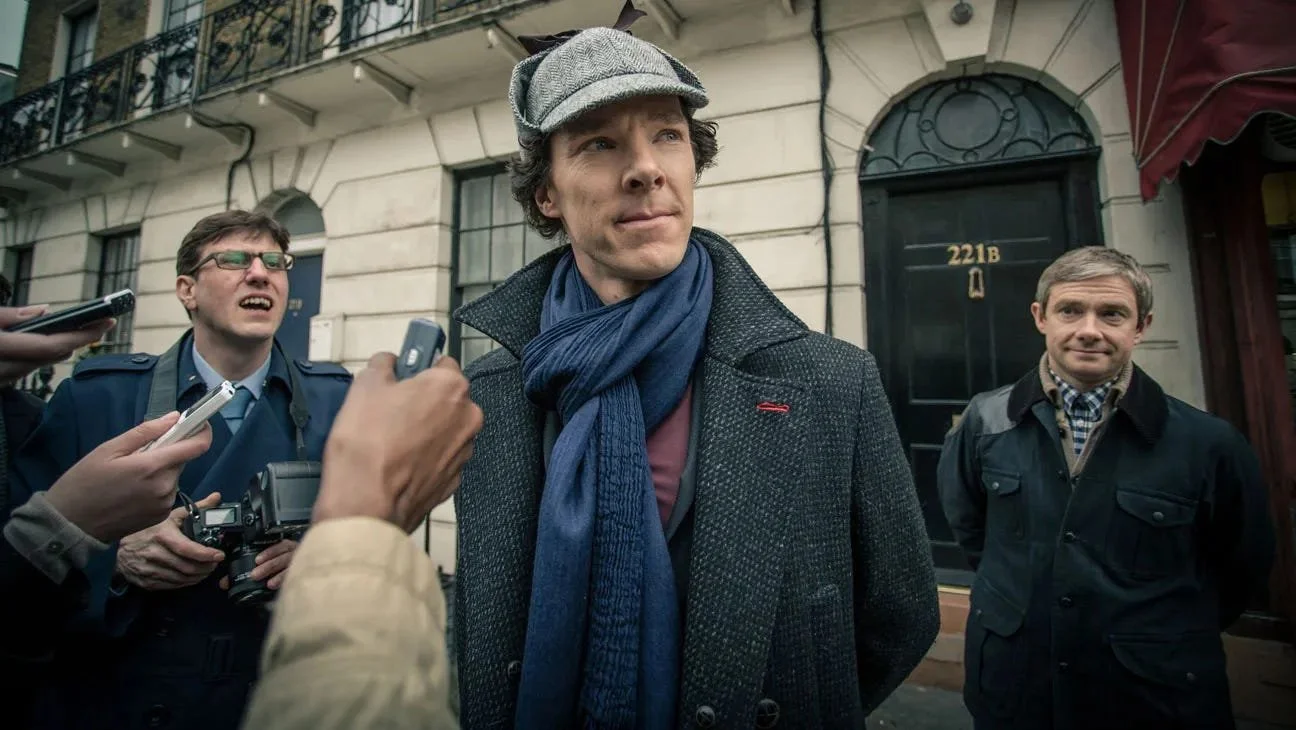
A screen grab from BBC’s Sherlock series.
Something had been gnawing at me for years about the much-loved reinvention of Arthur Conan Doyle’s character Sherlock Holmes. Something about it didn’t add up. Since I am no Sherlock Holmes, it took me years to finally figure it out.
I think it may have to do something with the appreciation for community I have developed over the last few years.
BBC’s series Sherlock is great in many ways. Mostly, these are dramatic in nature - texts on screen, sharp dialogue, iconic and memorable main characters. It also has a breathless sense of pacing that seems to reflect the way Sherlock himself thinks.
But there is an assumption that underlies the show’s main conceit - Sherlock’s amazing competence at solving crimes and catching criminals - that just doesn’t float.
The show assumes that intelligence = competence. This simply isn’t true.
I mean, in an classroom setting, where problems are basically equations on paper, removed from the context of real life and real human beings, someone can be really good at arriving at the correct conclusion. But everywhere else, raw smarts is only one part of the puzzle.
The plans Sherlock makes come into effect with pinpoint precision. Sometimes so well that it is a surprise to John Watson himself, the man who hardly ever leaves Sherlock’s side. Somehow, Sherlock forms a plan with several moving parts and orchestrates events with such masterful expertise that everything comes to fruition in exactly the right way, at the exactly right moment.
But raw intelligence, however great it might be, is not sufficient to achieve this. The world is full of really smart people who are helpless to bring their plans into effect. If intelligence was the only thing required, the world would be a very different place.
The quality that Sherlock would need to actually be that good at executing his complex plans is sorely missing in him, and the show actually reminds us of this over and over again.
Sherlock lacks people skills.
He is terrible with people. He struggles to communicate with them and often ends up insulting or berating them without intending to. He sometimes even knowingly drives them away because he is supposedly repelled by their mediocrity. The few people who manage to stick around because they genuinely love him are often kept in the dark about his plans.
All this being true, there is no way his plans can actually work. Not unless his greatest secret is that he is a kind and gregarious individual carefully concealing his humanity from John Watson and the audience.
Some years ago, I read a report about why a lot of Indian engineers were unemployable. One of the dominant reasons cited was their lack of communication skills. Even promising ones who were reasonably good in their field couldn’t land a job because they didn’t know how to communicate their ideas to a colleague in a professional setting.
I think the root of this problem might be our conviction that intelligence is all that matters. A conviction that would seem to be at the root of even the Indian caste system, with its entirely impractical Brahmin-topped hierarchy. The people at the top, who are in charge of making rules about how society should function, can’t be solely focused on knowledge-gathering and study. If their work involves dealing with people and solving their problems, then their approach towards that work has to be informed by at least some amount of empathy. But our scriptures, fanboying over knowledge, have little to say on the matter. Indeed, they have little to offer to anyone except their own authority.
But I digress. Back to the show.
Sherlock’s elder brother Mycroft Holmes is also smart and competent, although in his case, the competence is somewhat easier to swallow. He is after all, employed at an intelligence agency. Even though he seems similarly challenged in the people skills department, he at least has competent people working under him who, when ordered, can execute his plans expertly.
Sherlock’s sister, however, is a perfect example of mythologised intelligence. She is so smart that her extraordinarily complex plan bamboozles both Sherlock and Mycroft. She is also, literally in a high-security prison, with no access to anyone or anything. She manipulates the people in the prison and through them, people outside the prison, and through them eventually the entire system.
The series has a hand-wavy approach to explaining processes that makes smart people look like superhuman beings who can magic conclusions, and even outcomes of plans, out of thin air. While it makes for fancy viewing, such a mode of storytelling can potentially create unhealthy social expectations.
When I was digressing towards caste a couple of paragraphs ago, we saw how turning intelligence into a uniquely valuable virtue can devalue compassion towards the labouring members of society. In addition to that, a case can be made about how repeated examples of cold and cerebral individualist heroes in fiction devalue protagonists who draw their power from a community of peers.
There is precedent for this kind of thinking in science too. Lynn Margulis was an evolutionary biologist who pushed back against the ‘survival of the fittest’ conceptualisation of how evolution works. Her view was that we can’t define life on earth using what we have observed animals (such as humans and all that led to them) doing. Animal life is a relatively new phenomenon. Before that, for eons, life on Earth was defined by microbes. It was only when bacterial life forms started cooperating with each other that larger life forms began to come into existence. Therefore, looking at today’s competing animals and coming to the conclusion that evolution proceeds through competition is like looking at a guy who has had a job for a day and coming to conclusions about how the office works. If life on earth is going to be defined, it should be on the basis of those who have lived here the longest.
Popular media, both fiction and non-fiction, is full of rugged heroes who can do everything by themselves. Personal competence is attractive to audiences because it serves as a wish fulfilment fantasy. If it’s not intelligence, it is military training. If it’s not military training it is swordsmanship. If it’s not swordsmanship, it is some kind of unique magical ability. Who doesn’t wish they could do it all? Who doesn’t want to be independently badass? After all, aren’t our Trumps and Modis examples of this heroic archetype? Are they not singular individuals with the ability to do everything all by themselves?
But we are all incompetent without the people around us. No matter how rich the mythology of the rude, lonely and disconnected hero feels, every actual human being needs connections to achieve goals and solve problems. It is time we started centring community and cooperation in stories as a distinct problem-solving skill.